The “Burning Magnesium Ribbon” activity in the chemistry curriculum of Class 10 demonstrates a fundamental chemical process known as a combination reaction. This experiment involves the reaction of magnesium metal with oxygen from the air to form magnesium oxide, a new compound, showcasing how elements combine to form more complex substances.
Activity 1.1 Burning of a Magnesium Ribbon in air
Materials Needed:
- Magnesium ribbon: A thin strip of magnesium metal that serves as the reactant.
- Safety equipment: Protective goggles, lab coat, and gloves to ensure safety from the intense light and heat produced.
- Ignition source: A Bunsen burner or a matchstick to ignite the magnesium ribbon.
- A container or a clamp to hold the magnesium ribbon.
Steps of the Activity:
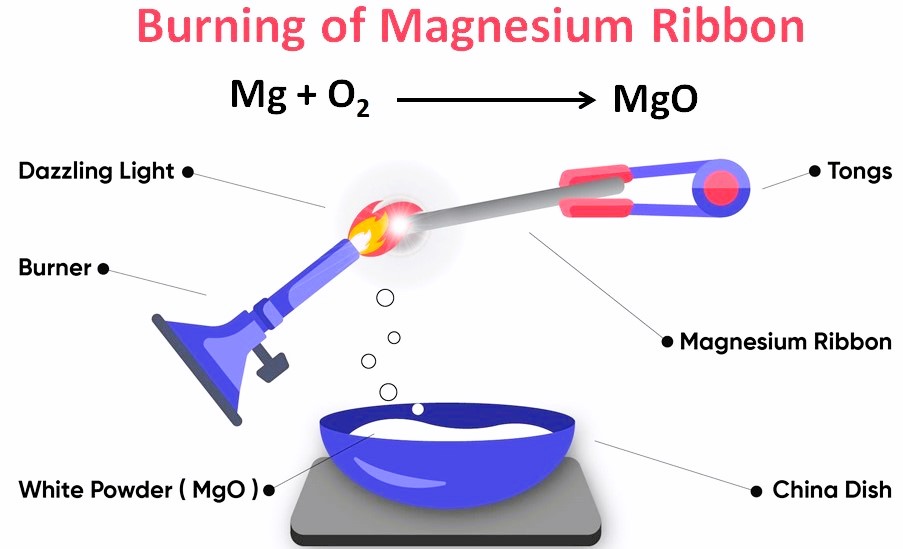
- Preparation: Clean the magnesium ribbon with sandpaper to remove any oxide layer, ensuring a more vigorous reaction.
- Ignition: Hold the magnesium ribbon with tongs or a clamp and ignite it using the Bunsen burner or matchstick, keeping it at a safe distance to avoid the bright light harming the eyes.
- Observation: Watch as the magnesium burns with a brilliant white light, forming white ash, which is magnesium oxide.
Also Check – Why should a magnesium ribbon be cleaned before burning in air?
What to Look For:
- The intense white light and heat indicate the exothermic nature of the reaction.
- The white ash formed, which is magnesium oxide, showing the transformation from a metal to an oxide.
Why It Happens:
- The reaction is an example of oxidation, where magnesium loses electrons to oxygen, forming MgO. This is a combination reaction where two elements combine to form a single product.
Importance of the Activity:
- Demonstrates the principle of combination reactions in chemistry.
- Highlights the concept of oxidation and reduction.
- Engages with the conservation of mass principle, as the mass of magnesium and oxygen before the reaction equals the mass of magnesium oxide produced.
This activity not only illustrates the chemical reaction process but also emphasises safety in chemical experimentation, the conservation of mass, and the transformation of substances at a molecular level, making it a comprehensive educational experience.
Viva Questions for Activity 1.1 – Burning of Magnesium Ribbon
Section A: Observation-Based Questions
Q1. What did you observe when magnesium ribbon was burnt? Ans. Magnesium ribbon burns with a dazzling white flame and changes into a white powdery ash.
Q2. What is the colour of magnesium ribbon before and after burning? Ans. Before burning: Silvery white and shiny. After burning: White powder (ash).
Q3. What is the white powder formed after burning magnesium ribbon? Ans. The white powder is magnesium oxide (MgO).
Q4. Why does magnesium burn with a dazzling white flame? Ans. Because a large amount of heat and light energy is released during the reaction. It is an exothermic reaction.
Section B: Explanation & Chemical Equation Questions
Q5. Write the word equation for this reaction. Ans. Magnesium + Oxygen → Magnesium oxide
Q6. Write the balanced chemical equation for the burning of magnesium ribbon. Ans. 2Mg(s) + O₂(g) → 2MgO(s)
Q7. What type of reaction is this? Give one reason. Ans. It is a combination reaction because two substances (Mg and O₂) combine to form a single product (MgO). It is also an exothermic reaction because heat and light are released.
Q8. Is this an oxidation reaction? Explain. Ans. Yes. Magnesium gains oxygen to form magnesium oxide. Therefore, magnesium is oxidised.
Q9. Identify the reactants and product in this reaction. Ans. Reactants: Magnesium (Mg) and Oxygen (O₂) Product: Magnesium oxide (MgO)
Section C: Reasoning & Why Questions (Most Important)
Q10. Why should magnesium ribbon be cleaned with sandpaper before burning? Ans. Magnesium is a reactive metal. It reacts with oxygen and moisture in air and forms a thin layer of magnesium oxide on its surface. This layer prevents the ribbon from burning easily. Cleaning with sandpaper removes this oxide layer and exposes fresh magnesium metal.
Q11. What would happen if we burn the magnesium ribbon without cleaning it? Ans. It will not burn easily or vigorously because the oxide layer acts as a barrier.
Q12. Why do we use tongs to hold the magnesium ribbon? Ans. Magnesium burns at a very high temperature. Holding it with tongs keeps our hands safe from burns and allows us to hold it properly in the flame.
Q13. Why is it advised to burn the magnesium ribbon away from the eyes? Ans. The flame is extremely bright (dazzling white) and can damage the eyes.
Q14. How do you know that a chemical reaction has taken place in this activity? Ans. We can confirm it because of the following changes:
- Change in colour (silvery white → white)
- Change in state (ribbon → powder)
- Evolution of heat and light energy
- Formation of a new substance (MgO)
Section D: Safety & Practical Questions
Q15. What safety precautions should be taken while performing this activity? Ans.
- Wear protective eyeglasses.
- Burn the ribbon away from the eyes.
- Use tongs to hold the ribbon.
- Perform under teacher’s supervision.
- Do not look directly at the bright flame.
Q16. Why is teacher’s assistance required in this activity? Ans. Because it involves burning at high temperature and produces a very bright flame which can be harmful if not handled properly.
Section E: Higher Order / Application Questions
Q17. What is the physical state of magnesium oxide formed? Ans. It is a solid (white powder).
Q18. Can this reaction be reversed easily? Why or why not? Ans. No, it is very difficult to reverse because magnesium oxide is a stable compound and does not easily decompose back into magnesium and oxygen under normal conditions.
Q19. Give two examples of combination reactions from daily life. Ans.
- Burning of coal: C + O₂ → CO₂
- Formation of water: 2H₂ + O₂ → 2H₂O
Q20. Why is respiration considered an exothermic reaction? How is it similar to this activity? Ans. Respiration releases energy (like this activity). In both cases, oxidation takes place and energy is released in the form of heat.
Q21. What is the difference between a physical change and a chemical change? Give one example from this activity. Ans.
- Physical change: No new substance is formed (e.g., melting of ice).
- Chemical change: New substance is formed with different properties (e.g., burning of magnesium ribbon forms MgO).
Q22. Name the type of energy change taking place in this reaction. Ans. Exothermic reaction (heat + light energy is released).
Bonus / Tricky Questions (For Good Students)
Q23. Why is magnesium oxide used in antacids? Ans. Magnesium oxide is basic in nature. It neutralises excess acid in the stomach.
Q24. What happens when magnesium oxide is dissolved in water? Ans. It forms magnesium hydroxide (a base): MgO + H₂O → Mg(OH)₂
Q25. In this reaction, which element is oxidised and which is reduced? Ans. Magnesium is oxidised (gains oxygen). Oxygen is reduced.
Quick Tips for Viva
- Always start answers with the observation first, then explain the reason
- Mention “exothermic + combination + oxidation” together when asked about the type of reaction.